

Canon PowerShot Models Worth Knowing: Why These Discontinued Digicams Are Becoming Harder to Find
Why discontinued Canon PowerShot and Digital ELPH cameras now exist in a finite surviving supply, which model families matter, and how to judge condition without getting swept up in hype.
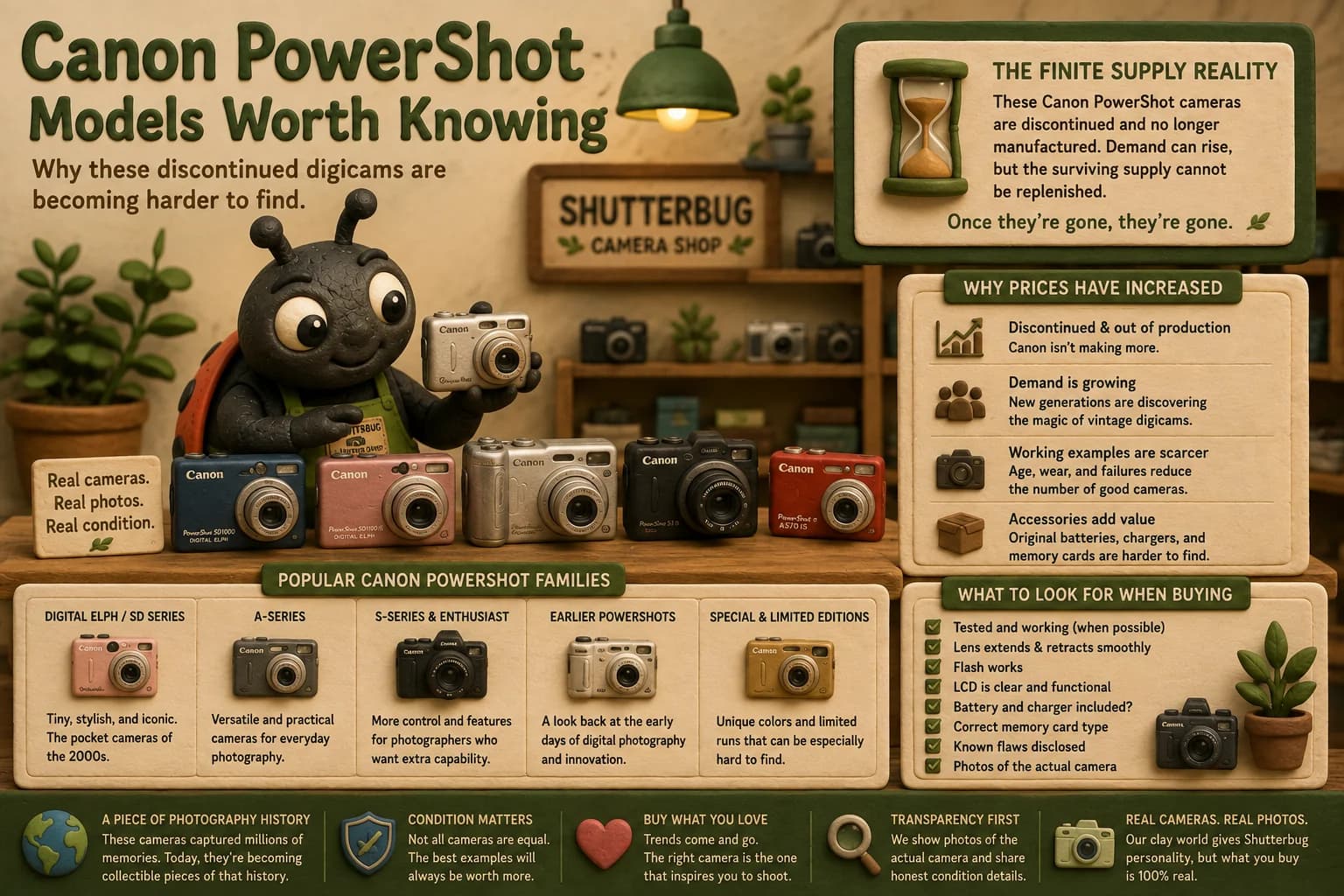
There was a time when Canon PowerShot cameras were everywhere. They were in purses, backpacks, glove compartments, desk drawers, and vacation bags. They photographed birthdays, school dances, family trips, concerts, nights out, and millions of completely ordinary moments before smartphones became the camera most people carried every day.
Then technology moved on. Production ended. People upgraded. Cameras were packed away, donated, sold, broken, lost, or simply forgotten.
And something interesting happened: the cameras that once seemed completely ordinary became a finite resource.
They aren't making these cameras anymore
The classic Canon PowerShot and Digital ELPH models people are rediscovering today are discontinued products.
Canon isn't continuously manufacturing another supply of PowerShot SD1000s, SD1100s, SD-series ELPHs, or the other compact cameras that defined the 2000s. Whatever examples still exist are essentially what we have left.
That does not mean every Canon PowerShot is extraordinarily rare. Millions of compact digital cameras were originally produced. But every year, some of that surviving supply disappears as lenses fail, LCD screens stop working, battery doors break, electronics corrode, cameras are dropped, and replacement components become harder to source.
The number that matters today is not how many cameras Canon originally manufactured. It is how many clean, functioning examples remain available now, and that number can only get smaller.
Why has the price of some old digital cameras gone up?
People sometimes look at the price of an older compact camera and wonder how a digital camera this old can cost that much.
Age alone does not determine value. Supply and demand do. For many years, demand for older compact digital cameras was relatively low because smartphones had taken over casual photography and a 2007 point-and-shoot could easily seem obsolete.
Then photographers began rediscovering them. Younger buyers found an aesthetic they had not experienced the first time around. People who grew up with these cameras wanted them again. Social media introduced entire generations to direct flash, small CCD sensors, early JPEG processing, tiny metal bodies, and 2000s-era photography.
Demand could rise, but supply could not respond. Canon cannot simply increase production of a 20-year-old PowerShot. Buyers are competing for the cameras that already exist.
Working cameras are scarcer than cameras themselves
You may find plenty of old cameras sitting in drawers, thrift stores, estate-sale boxes, and online marketplaces. That does not mean there is an unlimited supply of good working examples.
A vintage digital camera needs multiple aging systems to continue working together.
- Retractable lens mechanism
- Autofocus system and image sensor
- LCD and built-in flash
- Buttons and zoom controls
- Battery contacts and memory-card interface
- Electronic boards, shutter components, and internal motors
A camera can look nearly perfect and still have a lens that refuses to extend. Another may power on but fail to save photographs, work except for the flash, or contain corrosion from a battery left inside for fifteen years.
Clean, tested cameras represent a smaller subset of the surviving population, which is one reason condition increasingly matters.
Canon PowerShot became an entire era of cameras
PowerShot was not one camera. It was an enormous family that ranged from inexpensive everyday point-and-shoots to sophisticated enthusiast cameras.
If you are new to the category, our beginner's guide to vintage digital cameras explains the broader types, batteries, memory cards, and buying considerations. Several Canon families are especially worth understanding.
Canon Digital ELPH and PowerShot SD cameras
For many people, this is the quintessential 2000s digital camera. Digital ELPH models combined remarkably compact bodies with optical zoom lenses, built-in flashes, simple controls, and often attractive metal construction.
They are exactly what many people picture when they hear vintage digicam today. Turn it on, let the lens extend, frame the shot, fire the flash, and take the picture. That direct experience is a major part of their appeal.
Canon PowerShot SD1000
The Canon PowerShot SD1000 has become one of the most recognizable cameras from this era. It is a tiny Digital ELPH with the rectangular styling associated with mid-2000s compact cameras.
It is not interesting because its specifications compete with modern equipment. They do not. Its design, flash photography, controls, JPEG rendering, size, and overall experience belong to a different stage of digital photography.
There will not be another original production run of SD1000s. Every working example changing hands today is a surviving discontinued camera, so condition becomes more important as model-specific demand grows.
The SD1100 IS and later Digital ELPHs
Canon continued evolving the ELPH formula with cameras such as the PowerShot SD1100 IS and numerous later SD models. Some added image stabilization, higher resolution, thinner bodies, different lenses, larger displays, or new controls.
Two cameras that look nearly identical can offer different shooting experiences. Certain colors and especially clean examples can also be much harder to encounter than ordinary versions.
Earlier PowerShot models
The further back you go, the stranger consumer digital photography becomes. Earlier PowerShots can be larger, slower, lower-resolution, and much more obviously products of early digital technology.
That is exactly why some collectors find them fascinating. They document the transition from film photography to the digital world we now take for granted, and their limitations are part of their historical character.
Canon PowerShot A-series
The PowerShot A-series deserves attention too. These were often practical family cameras with optical zoom, built-in flash, useful controls, and approachable designs rather than the fashion-focused bodies of ultra-compact ELPHs.
Several use readily available battery formats, which can make certain models especially convenient today. They may receive less social-media attention, but less-hyped PowerShot families are often where buyers discover interesting and usable cameras.
PowerShot S-series and enthusiast compacts
Canon also used the PowerShot name for more sophisticated compact cameras aimed at photographers who wanted something smaller than an interchangeable-lens system while retaining more control than a basic point-and-shoot.
PowerShot does not automatically mean a simple pocket camera. Canon applied the name across an enormous range of equipment, so the exact model matters.
Not every expensive camera is actually rare
A camera can become expensive for several different reasons.
- It is genuinely difficult to find
- Working examples are becoming scarce
- A specific color is uncommon
- Collectors want it
- Social-media demand surged
- A particular model became fashionable
- Included accessories are difficult to source
- Its condition is unusually good
Those are not all the same thing. Sometimes the camera itself is not exceptionally rare, but a clean, tested example with its battery and charger is. Vintage-camera pricing deserves more context than a listing that simply says RARE.
The finite-supply problem
Why vintage digicams are different: These original camera models are no longer manufactured. Demand can rise, but the surviving supply cannot be replenished.
Imagine there are 10,000 working examples of a discontinued camera in the broader market. The manufacturer is not making number 10,001. Some develop lens failures, some are damaged, others become parts cameras, and many disappear into permanent collections or forgotten storage.
At the same time, thousands of new people may discover the model. Demand can increase while the surviving supply continues to shrink. We cannot know exactly how many functional examples of a particular PowerShot remain, but the underlying principle is unavoidable: every original discontinued camera exists within a finite surviving population.
Why condition may matter more in the future
As these cameras continue aging, buyers may increasingly distinguish between untested cameras, parts cameras, working cameras, tested cameras, excellent cosmetic examples, complete kits, boxed examples, and unusually preserved units.
Collectors already make these distinctions with older film cameras, video games, watches, toys, and other discontinued objects. Digital cameras are not exempt from aging, and their complicated electronics can make preservation especially important.
Replacement parts aren't unlimited either
If a modern product breaks, replacement components may still be manufactured. For an older PowerShot, replacement parts often come from other old PowerShots.
- LCD screens and lens assemblies
- Battery doors and exterior housings
- Buttons and flash components
- Circuit boards, screws, and covers
A donor camera can keep another unit alive, but it also means one complete camera effectively disappears so another survives. Repair itself can contribute to the shrinking population of complete examples.
Batteries are replaceable. Cameras aren't.
Replacement batteries, chargers, and cables are still available for many popular vintage cameras, which is one reason some models remain practical to use.
Someone can manufacture another compatible battery or charger. They cannot manufacture another original 2007 Canon PowerShot SD1000. The original camera is the scarce asset.
Why real condition disclosure matters
Scarcity makes transparency more important, not less. A discontinued camera should not automatically become valuable just because it exists. Working condition, cosmetic condition, included accessories, and testing all matter.
A camera with significant wear but excellent functionality may be ideal for someone who wants to shoot every day. A collector may prioritize an exceptionally clean body. Another buyer may happily purchase a broken camera for parts. The important thing is knowing which one you are getting.
Real cameras, real photographs
Our website uses clay artwork because we wanted Shutterbug Camera Shop to have its own visual world. The inventory, however, is not made of clay.
On an actual product listing, buyers should see photographs of the real camera offered for sale. You are not ordering one identical factory-new unit from an endless warehouse. You are purchasing one particular surviving camera, with its own scratches, accessories, and individual condition.
Should you buy a PowerShot as an investment?
We would not recommend treating vintage digital cameras as guaranteed investments. Nobody can promise that a particular camera will increase in value. Trends and prices can move in both directions.
Buy the camera because you like it, want to photograph with it, collect it, or appreciate what it represents. Any future increase in value should be secondary to enjoying the camera itself.
The cameras we took for granted are becoming history
These cameras were not originally designed to become artifacts. They were everyday consumer electronics bought at electronics stores, carried to school, tossed into purses, and taken on family vacations.
Few people looked at a Canon PowerShot on a retail shelf and thought it needed to be preserved because production would stop someday. Yet an entire generation of compact digital cameras was produced, used, replaced, and discontinued. We are now realizing that some were much more interesting than we gave them credit for.
Which Canon PowerShot should you buy?
There is no single answer. For the classic pocket-camera experience, explore Digital ELPH and SD models. For something less hyped, look through Canon's enormous A-series and broader PowerShot catalog. For more control, investigate enthusiast-oriented models.
Do not automatically assume the model with the highest online price is the best camera for you.
- Condition and tested status
- Battery and charger availability
- Memory-card compatibility
- Flash and lens operation
- Included accessories
- Size and design
- The photographs you actually want to take
Browse current Canon PowerShot inventory with those practical details in mind.
Once they're gone, they're gone
Vintage digital cameras occupy an unusual moment in technology. They are new enough to feel familiar but old enough that production ended years ago. Every Canon PowerShot that survives today has already made it through years of use, storage, technological change, and obsolescence.
Some will survive another twenty years. Some will not survive another twenty months. These cameras deserve more respect than the phrase old electronics suggests. They are discontinued pieces of photography history, and once a particular surviving camera is gone, there is not another brand-new one waiting behind it.
For people who enjoy the look, history, and experience of vintage digital photography, that is a big part of what makes finding the right one so much fun.