
A Beginner's Guide to Vintage Digital Cameras
Learn what gives older digicams their appeal, which batteries and memory cards matter, and how to choose a first vintage digital camera you will actually carry.
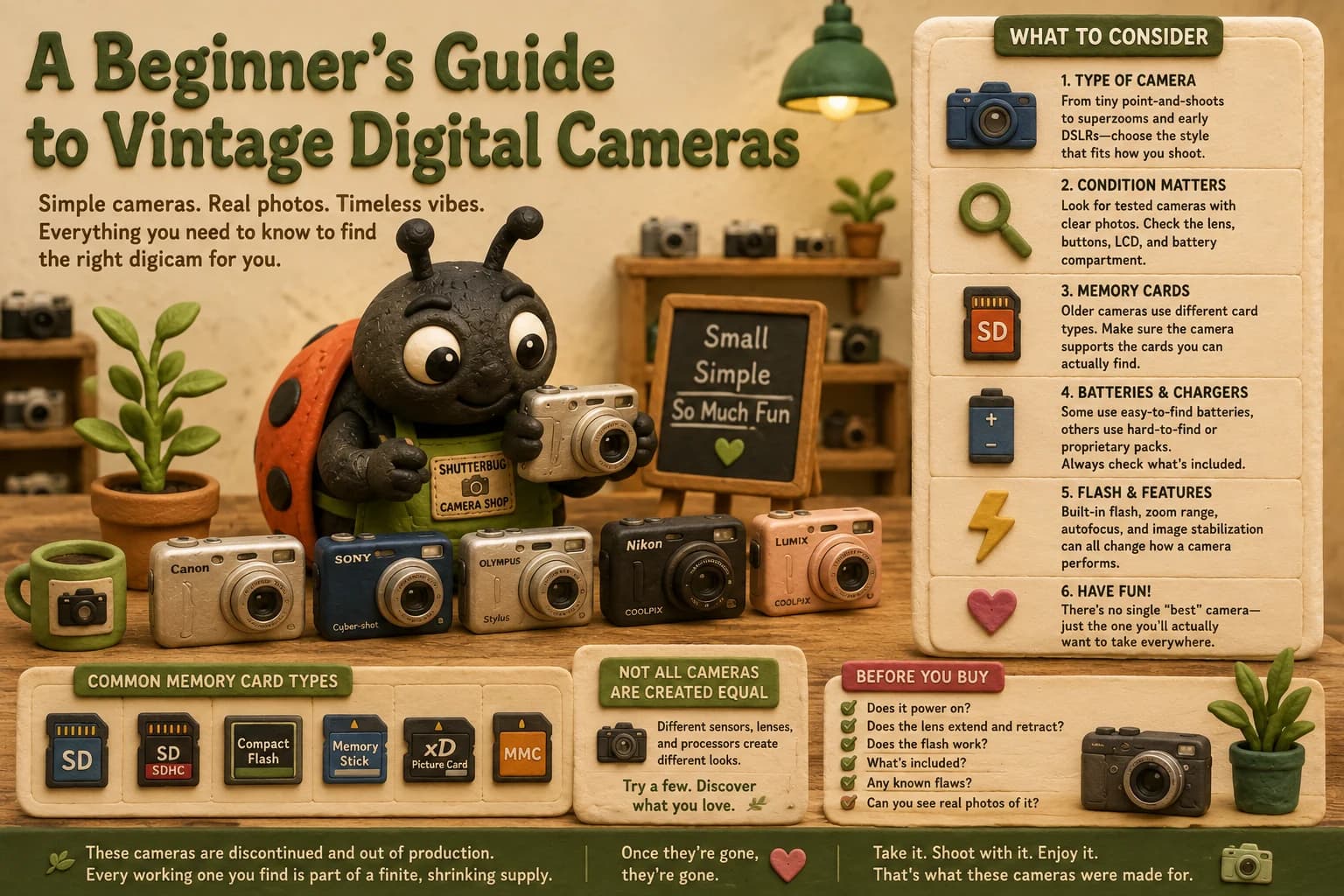
Vintage digital cameras have gone from forgotten drawer electronics to some of the most interesting cameras to shop for again. Compact cameras from the late 1990s, 2000s, and early 2010s are being rediscovered for their small size, distinctive image character, simple controls, built-in flashes, and the nostalgia of taking photos without relying on a phone. Browse the vintage digital camera collection to see how varied these cameras can be.
You will see names like Canon PowerShot, Sony Cyber-shot, Olympus Stylus, Nikon Coolpix, Kodak EasyShare, Fujifilm FinePix, Panasonic Lumix, and Casio Exilim come up constantly. If you are buying your first vintage digital camera, the number of models can get overwhelming quickly.
You do not need to know every camera ever made. You just need to understand what separates one old digital camera from another.
What counts as a vintage digital camera?
There is no official cutoff. For most people, the term refers to digital cameras old enough to feel noticeably different from modern smartphones and current mirrorless cameras. That often includes cameras from roughly the late 1990s through the early 2010s.
Some buyers specifically want early-2000s compact cameras. Others are drawn to later point-and-shoot models from around 2008 to 2012. A camera does not need to be extremely old to offer a vintage-digital look or experience. The technology, design, controls, and image character matter more than a strict date.
Why are vintage digital cameras popular again?
Part of the appeal is nostalgia. Before smartphones became the default camera, a small digital point-and-shoot was something you carried to the moments that mattered.
- School events and birthday parties
- Vacations and road trips
- Concerts and nights out
- Family gatherings
- Everyday snapshots
There is also something appealing about using a dedicated device instead of a phone. You turn it on, take the photo, and move on. No notifications or social feed, just a small camera in your hand.
The digicam look
The phrase digicam look does not describe one exact visual style. It usually refers to characteristics associated with older compact cameras and their in-camera JPEG processing.
- Direct built-in flash
- Strong contrast
- Cooler or warmer color rendering
- Visible digital noise
- Smaller sensors
- Limited dynamic range
- Slightly imperfect exposure
- Distinctive nighttime photos
Modern cameras and phones are technically better in almost every measurable way, but technically better is not always the same as visually more interesting. Direct flash, a little noise, and unmistakably early-2000s color can create photographs that feel very different from modern smartphone images.
CCD cameras and why people talk about them
CCD stands for Charge-Coupled Device, one type of digital image sensor. Many older compact cameras used CCD sensors before CMOS became dominant, which has led to plenty of discussion about whether CCD cameras have a special look.
There can be real differences between older cameras, but sensor type alone does not determine the final image. The specific model matters more than a single specification.
- Sensor and lens
- Image processor and firmware
- White balance and exposure system
- Color processing
- Noise reduction
- Flash behavior
Megapixels aren't everything
One of the easiest beginner mistakes is assuming more megapixels automatically means a better camera. It does not. Vintage digital cameras range from only a couple megapixels to well over 10 megapixels, and a 7-megapixel camera can still produce excellent photos for social media, small prints, and everyday use.
Some sought-after vintage compacts do not have impressive modern specifications. People buy them because of how they shoot and how the images look, not because they win a specification contest.
Start with the type of camera you want
Before choosing a brand or model, decide what kind of experience you want. The broad point-and-shoot camera collection is a useful place to compare compact digital and film options.
- Compact point-and-shoot: small, simple, pocketable, and built around an integrated lens and flash
- Superzoom camera: larger than a pocket camera, with a long zoom and no need to change lenses
- Early DSLR: a larger sensor, optical viewfinder, interchangeable lenses, and more manual control
- Rugged compact: designed for travel and rough use, though old waterproof seals should never be trusted automatically
Canon PowerShot
Canon's PowerShot line is one of the biggest names in vintage digital cameras. Canon PowerShot cameras range from tiny pocket models to advanced enthusiast compacts and larger zoom cameras.
The Digital ELPH series became known for small metal-bodied cameras that were easy to carry. The exact model still matters: two PowerShots released several years apart may use completely different batteries, storage, controls, sensors, and lenses.
Sony Cyber-shot
Sony made everything from tiny fashion-oriented cameras to high-zoom models and more advanced compacts. Many older Sony Cyber-shot cameras use Memory Stick media rather than standard SD cards.
Some models also require proprietary batteries and chargers. The cameras can be great, but accessory compatibility becomes especially important as they age.
Olympus Stylus
Olympus Stylus cameras developed a following for their compact size and distinctive designs. The Stylus name was used across film and digital cameras, so it is important to know which one you are viewing. Browse Olympus digital cameras for the pocketable digital side of the family.
Olympus also made rugged Stylus Tough models intended for harsher environments. Age should always be considered before relying on the original waterproof claims of an older camera.
Nikon Coolpix
Nikon's Coolpix family covers an enormous range, from basic pocket cameras to models with longer zooms, more controls, and unusual designs. Nikon Coolpix cameras can be a good starting point if you want a recognizable camera brand with many used options.
Kodak EasyShare
Kodak EasyShare cameras are closely tied to early consumer digital photography. They were designed for people who wanted to take pictures without learning complicated controls, making them a strong example of the early-2000s digital-camera experience.
Pay close attention to battery type, memory compatibility, and whether proprietary accessories are required.
Fujifilm FinePix
The FinePix name covered everything from small compact cameras to larger bridge-style models. Fujifilm has a long history in photography, and older FinePix cameras can offer interesting designs and image characteristics.
Some older models use xD-Picture Cards rather than SD cards, which is worth confirming before you buy.
Memory cards can be surprisingly complicated
Older cameras lived through a period when several competing storage formats existed. Even when a card physically fits, capacity limits can matter. A camera may work perfectly with a 512MB card while refusing to recognize a modern 64GB card.
- SD and SDHC
- CompactFlash
- Sony Memory Stick
- Memory Stick Duo
- xD-Picture Card
- SmartMedia
- MultiMediaCard
Always check memory compatibility for the exact model.
Batteries and chargers matter just as much
A cheap camera stops being a bargain quickly if it requires a difficult-to-find proprietary battery and charger. Some cameras use common AA batteries, while others use rechargeable lithium-ion packs specific to one camera family.
- What battery the camera uses
- Whether the battery is included
- Whether a charger is included
- Whether replacements are still available
- Whether the battery is proprietary
- Whether the camera can charge internally
Battery condition varies greatly with age. An original battery that powered a camera for hours in 2007 may barely hold a charge today.
Look closely at the lens
Compact digital cameras often use retractable zoom lenses, and that mechanism can become a failure point. A camera that looks perfect cosmetically can still have a damaged lens mechanism.
- The lens extends properly
- The lens retracts properly
- Optical zoom works
- Autofocus works
- The lens does not make unusual noises
- The camera does not display a lens error
The flash is part of the experience
If you are chasing a classic 2000s nighttime look, the built-in flash matters. Direct flash can produce hard shadows, bright faces, dark backgrounds, and that unmistakable party-photo appearance.
If that is the look you want, make sure the flash is tested when possible.
LCD screens can age too
A damaged LCD does not always make the camera unusable, but its condition should be disclosed.
- Dead pixels
- Dim backlights
- Color shifts
- Lines or dark spots
- Scratches
- Delamination
Condition is more important than hype
Certain camera models can become popular online very quickly, and prices may rise simply because a model appears repeatedly on social media. Popularity does not automatically make that camera the best choice for you.
A less-hyped model in excellent working condition may be a much better purchase than a trendy camera with a failing lens, damaged screen, or missing charger. Always evaluate the actual camera being sold.
What should a beginner spend?
There is no single correct amount. Vintage digital-camera prices vary enormously. For a first camera, it usually makes more sense to prioritize a functional model you enjoy using rather than immediately chasing the rarest option.
- Model and working status
- Cosmetic condition
- Color and rarity
- Included accessories
- Online popularity
Should you buy the trendiest model?
Not necessarily. One of the best things about vintage digital cameras is how many models exist. A camera does not need to be famous to be fun, and finding overlooked models is part of the appeal.
What to check before buying
These questions matter more than whether a listing calls a camera rare or retro.
- Does it power on, and has it been tested?
- Does the lens extend, retract, zoom, and focus?
- Does the flash fire?
- Does the LCD function?
- What memory card does it use?
- What battery does it use?
- Are the battery and charger included?
- Are replacement batteries available?
- What other accessories are included?
- Are there known flaws?
- Are you seeing photos of the actual camera?
Tested vs. untested
When something hasn't been tested, we'd rather say that than guess.
An untested camera is not necessarily broken, but it is not necessarily working either. There may be an understandable reason it was not tested, such as a missing charger or uncommon battery. The important thing is knowing what you are buying.
At Shutterbug, tested status should mean something. Read how we test used cameras for a detailed look at the checks we make and how we describe anything we could not verify.
Parts and repair cameras
Vintage cameras can also have value as repair projects. A failed camera may still contain useful battery doors, LCD screens, buttons, lens assemblies, covers, flash assemblies, body panels, or circuit boards. That is why parts and repair cameras should be clearly identified instead of presented as functioning equipment.
Don't forget the size
One of the most enjoyable things about older compact cameras is their size. A camera small enough to slip into a jacket pocket is more likely to come with you than something that requires a dedicated bag.
If you are looking for an everyday digicam, dimensions and weight may matter more than specifications.
Vintage digital cameras aren't smartphones
Expectations matter. A 2006 compact camera may focus more slowly, take longer to start, have a low-resolution screen, struggle in very dark conditions, offer limited battery life, shoot slowly, use outdated memory, or record low-resolution video.
That does not make it bad. That is the experience. Buying an older camera because you want it to behave exactly like a modern smartphone misses much of what makes these cameras interesting.
There is no single best vintage digital camera
The best camera depends on what you want. Hundreds of models are worth discovering.
- Want something tiny? Look at compact point-and-shoots.
- Want direct-flash party photos? Prioritize a tested flash.
- Want manual controls? Look at advanced compacts or older DSLRs.
- Want early-2000s nostalgia? Choose a camera from the period.
- Want something unusual? Dig into less-famous models.
The actual camera matters
Shutterbug Camera Shop uses clay artwork because we wanted the store to have a distinct visual identity. When you are looking at an item for sale, however, the actual camera is what matters.
Our product listings are intended to show photographs of the real physical item, not a clay substitute or generic stock representation. Used cameras are individual objects, even when they share the same model number.
That is why real product photos, testing notes, included accessories, and honest condition descriptions matter.
Start with a camera you'll actually carry
Your first vintage digital camera does not need to be the rarest, most expensive, or most talked-about model. It just needs to make you want to take pictures.
Find something that fits your style. Charge the battery. Put in a memory card. Throw it in your pocket, and take it somewhere. That is where the fun starts.