
Shutterbug camera guide
35mm Film Camera Buying Guide
The best first 35mm camera is the one whose controls, condition, and ongoing costs fit the way you want to shoot.
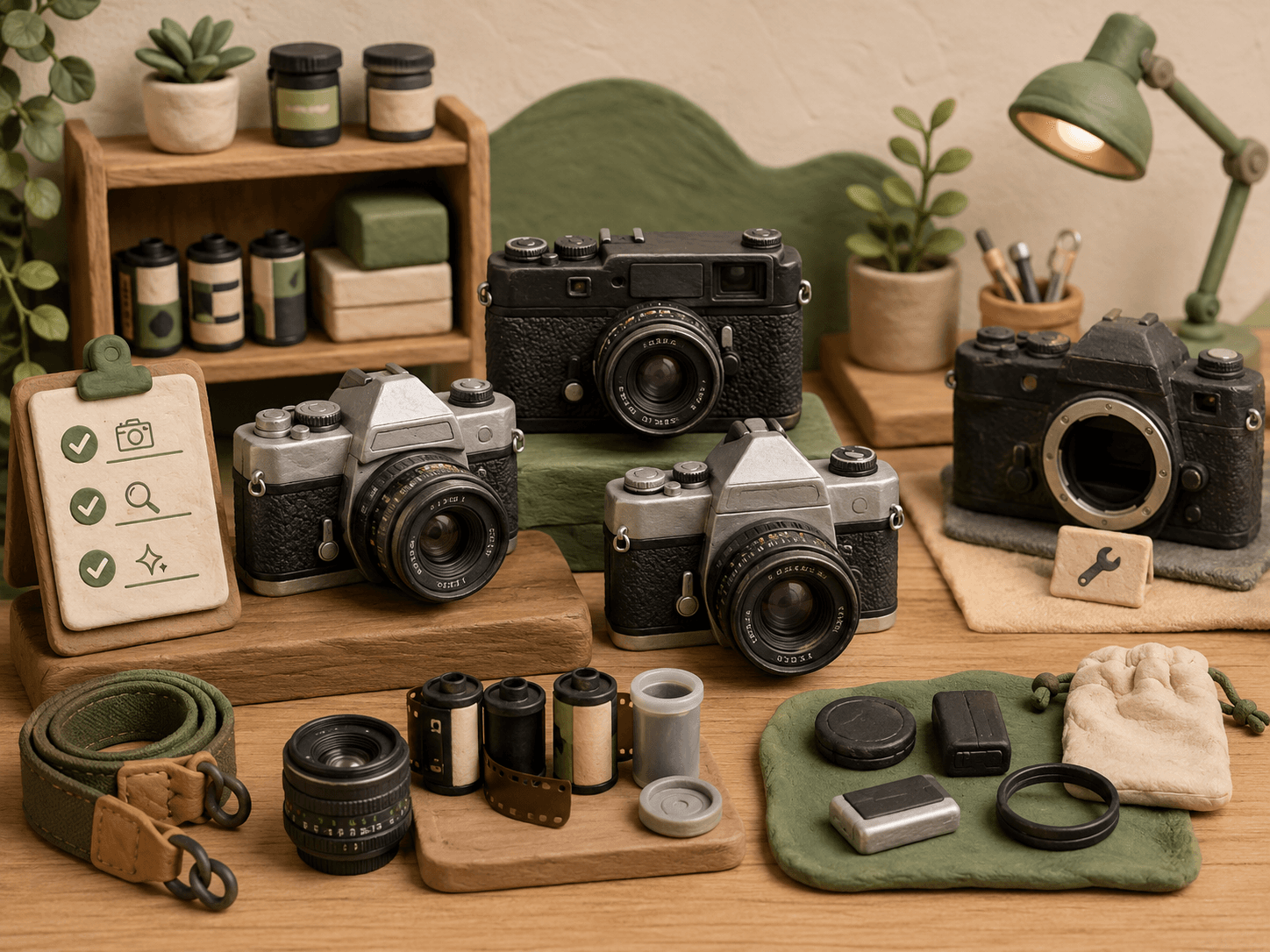
Choose a camera style
A 35mm point-and-shoot handles most exposure and focusing decisions for you. An SLR shows the scene through the taking lens and can support interchangeable lenses. A rangefinder uses a separate viewing and focusing system and often appeals to photographers who prefer a compact, quiet experience.
There is no universally best style. A simple automatic compact may make more photographs because it is always with you, while a manual SLR may be better for learning exposure and changing lenses.
- Point-and-shoot: compact and convenient
- SLR: direct lens viewing and broad control
- Rangefinder: separate finder and distinctive handling
- Reusable camera: lower risk than an unknown decorative collectible
Understand mechanical and electronic dependence
Some cameras can fire their shutter without a battery, while others need power for nearly every function. A battery-independent mechanical shutter can be reassuring, but it does not eliminate the need to inspect speeds, curtains, advance, rewind, and seals.
Electronic cameras can offer accurate metering, autofocus, and automation. Confirm the battery type is available and inspect the compartment for corrosion or damaged contacts.
Read film transport and shutter notes
A camera must load, advance, expose, and rewind film reliably. Dry testing can confirm many controls, but it does not prove frame spacing, light tightness, or image results under every condition.
Shutter observations should identify whether it releases and whether speeds appear to change. Without specialized test equipment, a seller should not claim precise calibration based only on listening to the shutter.
- Film door and latch close securely
- Advance and rewind mechanisms move
- Frame counter responds
- Shutter releases and speeds visibly or audibly change
- Light seals and mirror bumper are described when visible
Inspect the lens, finder, and meter
For an included lens, review focus movement, aperture operation, mount condition, glass, and visible dust, haze, fungus, separation, scratches, or oil. A body-only camera needs a compatible lens before it can make photographs.
Viewfinders often show dust without affecting images, but heavy haze, damaged prisms, or misalignment can make composition difficult. Meter response is useful, yet older meters may still be inaccurate and should not be represented as calibrated without proper testing.
Budget beyond the camera
Film, processing, scans, batteries, a lens, a strap, and possible service all contribute to the real cost. A more complete tested kit can be a better value than a cheaper body with missing or uncertain essentials.
Start with one camera and one dependable lens. Learn the controls, keep notes on exposures, and use the results to decide what additional gear would genuinely help.